One system, three layers
10 October 2026
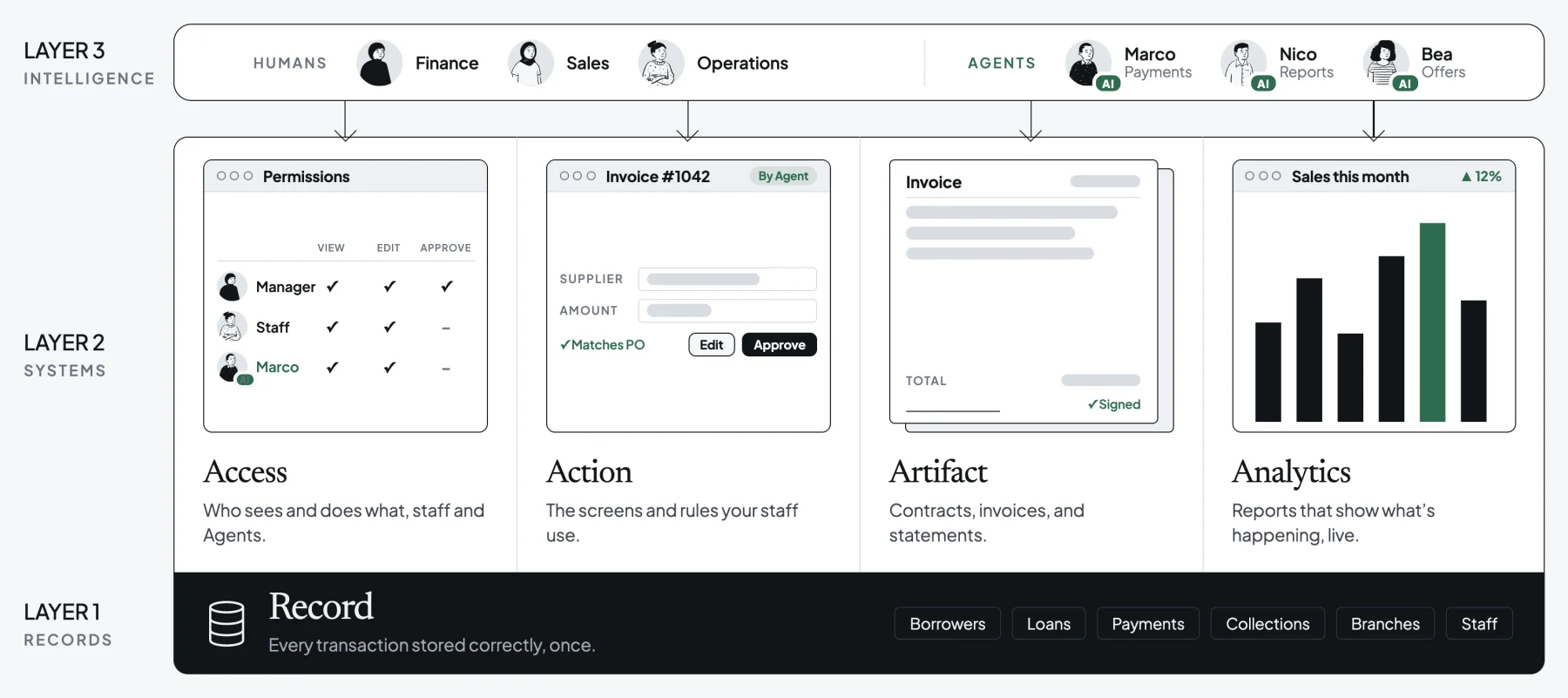
When we say intelligent software, we mean one system in three layers. Each layer stands on the one below it, and the order matters. AI added on top of messy records and spreadsheets stalls, however good the model is. AI built on a clean record, inside software that already runs the work, can take on real work.
Layer 1: Records
Every customer, order and transaction, stored correctly and only once. That sounds like the least interesting part of a system, and it is the part everything else depends on.
A good record does four things. It holds the core of the business: customers, orders, invoices, payments. It holds the fields only your business tracks, next to the standard ones, so nobody keeps a side spreadsheet. It gives each team the view it needs, such as open orders for one branch, sorted by age. And it logs every change, so you can always see who did what, and when.
When the same customer lives in a spreadsheet, a chat thread and a notebook, every report becomes an argument about which copy is right, and every new tool inherits the mess. Fix the record first and the layers above it get simpler.
Layer 2: The systems your team works in
This is the software your people open every morning. We build it in four parts, around how your business actually runs rather than how a product assumes it does.
- Access. Who can see and do what. A manager approves, staff edit, a new hire sees only their branch. The same rules apply to Agents, which matters later.
- Action. The screens and rules your staff work through. Forms built around the work, work routed to the next person automatically, and key changes held until someone approves them.
- Artifact. The paperwork the system writes for you: quotes, contracts, invoices, statements. Generated from the record, so nobody retypes figures from one place into another.
- Analytics. Reports that show what is happening as it happens: volume by day, branch or person, how long each step takes, and what is waiting, and where.
Most business software stops here. It stores the work and moves it along, and then waits for a person to decide what to do with it.
Layer 3: Intelligence
The layer that used to be only people
For as long as businesses have run on software, the top layer has been human. Systems kept the record and moved work from one screen to the next, but every judgment call fell to a person.
Someone decided which invoice belonged to which purchase order when the numbers didn’t quite match. Someone worked out which overdue account to chase first, and how firmly. Someone read last month’s figures and explained why sales in one branch had dropped. None of that is data entry. It is judgment, and until recently only people could supply it. So as the business grew, the judgment work grew with it, and the only way to keep up was to hire.
What changed
Agents can now make many of those calls. Not by following a script, but by reading the situation the way a careful colleague would, and saying why they decided what they decided.
Take a payment run, as an illustrative example. Thirty-five supplier invoices are due. Thirty match their purchase orders cleanly. Of the other five, the Agent pairs two invoices against one order because the goods arrived in two deliveries. It pays one invoice above the order price because the supplier agreed the increase by email, and notes where. It holds one that looks like a resend of an invoice already paid, and holds another because the goods haven’t arrived yet. Finance reviews five explained calls instead of thirty-five invoices, and approves the run.
That is the shift. The Agent didn’t just move data. It made the routine judgments, showed its working, and left the decision that matters to the person accountable for it.
How Agents work inside the system
An Agent works through the same doors as your staff. It sees only what its role allows, acts through the same screens and rules, and produces the same documents. It never reaches around the system to change the record directly.
Each Agent owns one role, such as payments, reporting or proposals. You can work with it in three ways. Brief it in chat like a colleague, and it does the work in the system rather than just replying. Give it a routine, and it runs every day without being asked. Or let it work until it reaches a limit you set, where it stops and waits for a person’s OK.
Where people stay
Agents taking on judgment doesn’t take people out of the picture. It moves them to where they are most useful. People set the limits: how much an Agent can approve, which customers it can contact, what it can spend. People make the calls above those limits. People decide what good looks like, handle the exceptions nobody planned for, and own the relationships with customers and suppliers.
Every Agent works under the same checks as staff: access by role, caps on volume, value and spend, approval for money and customer changes, and a log of every action. Any Agent can be paused at any time. Agents prepare, and your people decide.
Why it has to be built
Off-the-shelf software gives you somebody else’s version of the middle layer, and rarely a clean record underneath it. Adding AI on top of that gives you an assistant that can talk about your business but can’t work inside it.
Intelligent software has to fit the way your business works: your records, your rules, the calls your people make every day. That means it has to be built around your business, one layer on the next. That is the work we do.